
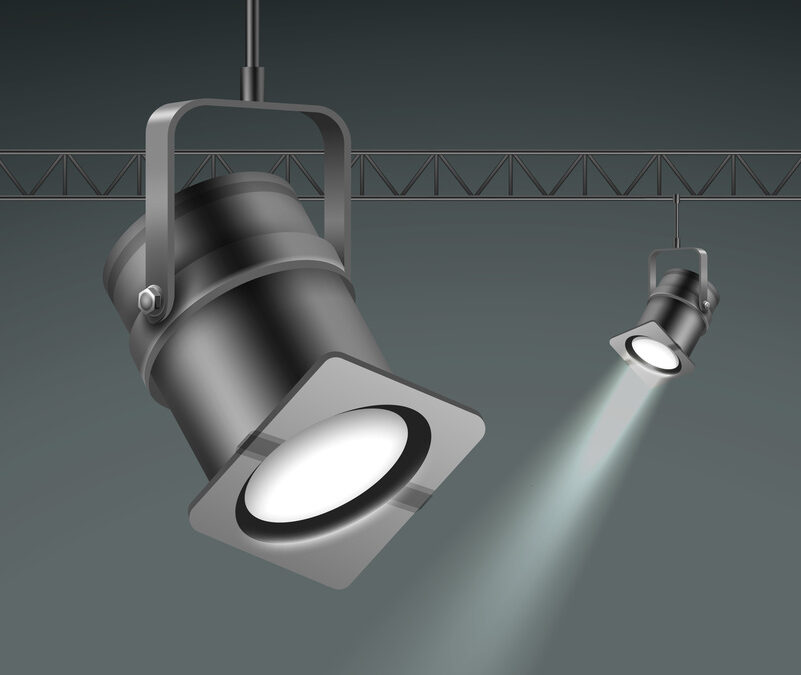
To choose track lighting, start with the job the light has to do, then pick the track heads, the voltage and the bulb in that order. Most homes and shops do well with 120V heads and LED bulbs, while low voltage heads suit small, precise accent light. Future Designs carries both in our track lighting line, along with the track and connectors in tracks and accessories.
What should you decide first when choosing track lighting?
Decide what the light is for. That one answer narrows the head, the bulb and how many you need.
- General light for a room: wider beams, spaced evenly along the track.
- Task light for a counter or work area: heads aimed at the surface, not at the person using it.
- Accent light for art, shelves or merchandise: narrower beams and heads you can adjust once they are up.
A room often needs more than one of these. Track handles that well, because each head on the same run can do a different job.
Should you choose 120V or low voltage track heads?
Choose 120V heads for general and task light, and low voltage heads for small, focused accent light. Our 120V track has an extruded aluminum housing, solid copper bus bars and a 20A maximum, and it mounts to a finished ceiling or hangs from a stem.
The Universal Track Light and the PAR gimbal heads are 120V heads that take a standard E26 medium base bulb, so replacement bulbs are simple to find. Our low voltage heads, such as the square and round styles, use MR16 bulbs, which are much smaller and work well for tight accent beams.
Which track head fits your space?
The head decides how the light looks and how far you can aim it. These are the main types in our catalog:
| Head | Bulb | Best known for |
|---|---|---|
| Universal | E26 medium base, LED or halogen | A simple 120V head in white, black, silver or satin nickel |
| PAR20, PAR30 and PAR38 gimbal | PAR bulb, E26 medium base | A ring that holds the bulb and tilts with it |
| GU10 gimbal | GU10 twist and lock | A compact head with a bulb that locks in |
| Low voltage gimbal, bullet and rocket | Low voltage | Small heads with 90 degrees of tilt and 330 degrees of rotation |
| Gooseneck | Low voltage | A 23 inch neck that brings the light closer to the subject |
| Projector | MR16, LED or halogen, 50W max | Blades that adjust the light pattern |
When does a built-in LED track fixture make more sense?
Choose a built-in LED fixture when you want light output and color fixed by the fixture, not the bulb. There is no bulb to buy, and each model is built for a specific job.
- Homes and lower ceilings: the Charge 8010 delivers 850 lumens at 3000K and CRI 90 from 11W, and it dims on ELV or TRIAC dimmers.
- Jewelry stores and retail: the Slimlux 40 is a linear fixture with 2450 lumens from 40W at CRI above 90. One fixture can light a showcase.
- Merchandise that changes: the Dialux 70 dims and changes color temperature from a remote control, fixture by fixture.
- App control: the Lumeon-AI offers CRI above 95, a 2700K to 6500K range and beam angles of 24, 30 and 60 degrees.
Which bulb should go in a track head?
Use the bulb the head is built for, and choose LED unless you have a reason not to. Most of the heads above accept LED or halogen, but LED runs cooler and uses less power for the same light. Bulbs are sold separately on the heads that take them, so match the base first:
- PAR20, PAR30 and PAR38: the higher the number, the wider the bulb. Each size needs a head made for it.
- MR16: a small bulb for low voltage heads and tight accent light.
- GU10: a twist and lock base for GU10 heads.
You can find these sizes in our LED light bulbs section.
Does your track type matter?
Yes. A replacement head has to match the track already on your ceiling, so check that before you order. For example, the Charge 8010 is stocked for H type track, and the Lumeon-AI is in stock for Halo track and available as a special order for Juno. If you are not sure what you have, contact us with the brand name printed on the track.
How do you plan the track layout?
Sketch the room first, then mark what each head needs to light. Longer rooms need longer runs and more heads. Then list the parts the layout needs:
- Live end connector: brings power in at the end of a run.
- Floating canopy live end: brings power in anywhere along the track, wired through a junction box.
- Straight connector: joins two sections in a clean, continuous run.
- T connector: joins three sections.
- Flexible connector: joins two sections at up to 90 degrees left, right, up or down.
Have a licensed electrician handle the wiring to the junction box.
Track lighting FAQ
What are the types of track lighting?
The most common is rigid straight track with adjustable heads, which is what we stock. Monorail track bends into custom shapes, and cable systems run heads along tensioned wires.
How do you change a track lighting bulb?
Turn the power off and let the bulb cool. Then remove it the way its base works: E26 bulbs unscrew, and GU10 bulbs twist and lift out. Fit the new bulb and turn the power back on.
What track lighting works for a jewelry store?
Linear LED track fixtures with a high CRI are the usual choice, because they show true color. Our Slimlux and Dialux fixtures are ideal for jewelry stores and retail, and one fixture can light a showcase.
Need help choosing? Tell us about your space and we will help you match the heads, bulbs and parts. Contact Future Designs or shop track lighting.